
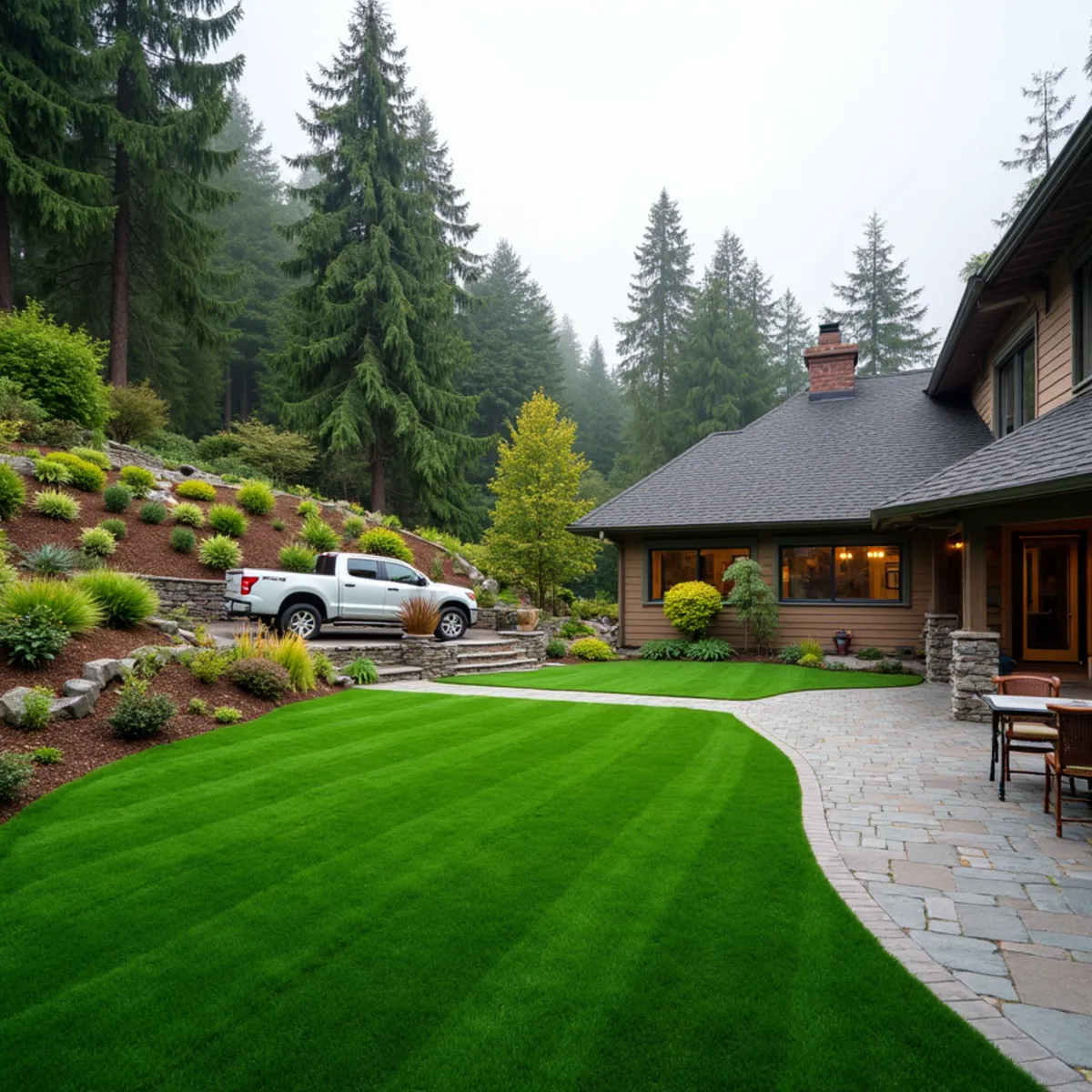
Auburn is really two cities stacked on top of each other. Down on the valley floor, the Green and White Rivers laid down deep alluvial silt that grows a lawn beautifully but shifts and settles under anything heavy. Up on Lea Hill, West Hill, and the Lakeland Hills plateau, the ground turns to firmer glacial till and steeper grades. A patio built for one of these settings will fail in the other, and that is the first thing our crews sort out on an Auburn estimate.
Working from Kirkland across King County for more than 14 years, Seattle Pro Turf builds paver patios, synthetic turf, retaining walls, yard drainage, and fire-pit living spaces sized to the ground under them. Auburn is squarely in our service area. Whether you are near the Green River on the flats or up on the plateau off 132nd, we compact, base, and edge every job so it stays flat and tight for the long haul. Fully licensed under WA SEATTPT839LN, bonded, and insured.
Local know-how
Alluvial river valley transitions to plateau hills; requires specialized soil compaction for large-scale paver patios.
Landscaping & Hardscape Built for Auburn
The valley soils around downtown, the Muckleshoot flats, and the industrial belt near Emerald Downs are young river deposits, soft and moisture-rich. Build a large paver patio on that ground without correcting for it and the field telegraphs every soft pocket within a season, dipping at the low spots and heaving at the edges. Our answer is disciplined subgrade prep: over-excavate the soft zones, lay a woven geotextile separation fabric so the silt cannot pump up into the base, then build and compact open-graded crushed rock in lifts before a single paver is set.
Climb onto Lea Hill or Lakeland Hills and the story changes to slope and glacial till. Here the pavers hold well, but water sheeting off the higher ground has to be managed or it will undermine the patio edge and pool against the house. We tie French drains and channel drains into the hardscape design so runoff from the plateau moves around the living space instead of through it. Auburn's ZIP codes 98001, 98002, and 98092 span both worlds, and we scope each project for the specific block it sits on.
Landmarks tell the same geographic story. The White River Amphitheatre, the Muckleshoot Casino, and the Green River corridor sit on the valley alluvium, while the residential plateaus above look down over Les Gove Park and the fairgrounds flats. That elevation split, valley silt below and compact till above, is why large-scale paver work in Auburn lives or dies on soil compaction and base design rather than on the pavers themselves.
More About Landscaping in Auburn
Two soils, one property: valley floor versus Lea Hill
Auburn splits between the Green River valley floor and the plateau shoulders at Lea Hill, West Hill, and Lakeland Hills, and the two demand different base prep. Down in the alluvial flats near the river and Les Gove Park the silty soil is soft and needs geotextile fabric plus deeper compacted crushed rock so a large paver patio doesn't dish over time. Up on Lea Hill the glacial till is firm but drains poorly, so we compact in lifts and add subsurface drainage. We plate-compact each layer and proof-roll the base before a single paver is set, because settlement on this ground shows up fast.
Large-format patios for Lakeland Hills and Plateau homes
The newer Lakeland Hills and Plateau subdivisions favor big, open entertaining spaces, and their poured-slab-era homes suit large-format concrete pavers with wide joints and a defined firepit zone. We build these on a contained, edge-restrained base so the field stays true across a broad patio. For sloped Lea Hill backyards we terrace with interlocking retaining block and step the grade, keeping any single wall under the four-foot WA permit threshold or engineering it when it must go higher. Synthetic turf pairs naturally with these patios here, giving a clean green apron that stays usable through the wet valley winter.
Drainage below Emerald Downs and the White River
The valley floor around Emerald Downs, Muckleshoot, and the White River sits low enough that the water table climbs in winter, and yards near the Green River can stay saturated for weeks. We address that with catch basins tied to a positive outfall and, where grades are flat, a French drain network that moves water off the lawn instead of letting it pond. On turf installs we raise the pad slightly and use a free-draining aggregate base so the surface sheds rather than holds. This is the difference between a valley lawn you can use in January and one that stays a mud pit.
Talk to a real local estimator
Free on-site estimate · 14+ years serving the Eastside
Common Auburn Yard Challenges We Solve
Soft valley silt under large patios
The alluvial soils near the Green and White Rivers settle unevenly under the weight of a big paver field. We over-excavate the soft subgrade, install geotextile separation fabric, and compact an open-graded base in lifts so the patio stays dead flat. Skipping that prep is the single most common reason valley-floor patios dip and rock within a year.
Runoff off the Lea Hill and Lakeland plateaus
Water sheeting down from the higher neighborhoods undercuts patio edges and collects against foundations on the slopes. We integrate channel drains and French drains into the hardscape so plateau runoff is captured and carried to daylight. That keeps the paver base dry and the joints locked instead of washing out.
Year-round mud in shaded valley yards
The moist valley air and rich silt keep low Auburn lawns wet and mossy long after the rain stops. Synthetic turf over a compacted, free-draining base gives families a clean, usable yard through the wet months. It is a particularly good fit for the tight lots near downtown where a natural lawn never fully dries.
Our Services in Auburn
We also handle emergency retaining wall repair, emergency drainage & sump pump, hillside slope stabilization, saturated turf sub-base repair, storm hardscape clearing & reset, backyard putting green installation, low-voltage landscape lighting, designer water features, and timber & composite deck construction for Auburn properties.
Why Auburn Residents Choose SeattleProTurf
Local to Auburn & King County
Because we are based in Kirkland, about 27 miles away, we know King County's permitting and the soil, slope, and drainage patterns on Auburn lots — not a generic playbook.
Built for Auburn's conditions
Every install is engineered for how water actually moves on your property. Alluvial river valley transitions to plateau hills; requires specialized soil compaction for large-scale paver patios.
Licensed, bonded & insured
Registered Washington contractor SEATTPT839LN, fully bonded and insured, with a workmanship warranty on every project.
Honest, line-item estimates
Your free Auburn estimate separates labor, materials, disposal, drainage, permits, and restoration — so you can compare bids on the same scope.
Auburn at a Glance
Neighborhoods
- Lea Hill
- Lakeland Hills
- West Hill
- Plateau
- Downtown Auburn
Landmarks
- White River Amphitheatre
- Emerald Downs
- Muckleshoot Casino
- Green River
- Les Gove Park
ZIP Codes
- 98001
- 98002
- 98092
“We put a big paver patio on our valley lot and were nervous it would sink like the neighbor's. Two summers in it is still perfectly level. The crew clearly knew this soft ground.”
Auburn Turf & Hardscape FAQs
The downtown and river-corridor soils are soft alluvial silt that compresses under load. Without proper over-excavation, separation fabric, and a compacted open-graded base, a heavy patio slowly presses into the subgrade and goes uneven. We build the base to carry the load so the surface stays flat.
Yes. On the plateau lots we design channel and French drains directly into the patio or wall so water coming off the higher ground is intercepted before it reaches your foundation or undercuts the hardscape. It is standard on any sloped Lakeland Hills or Lea Hill project we build.
It is. Riverside lots hold moisture and grow moss, and a natural lawn there stays muddy for months. Turf over a compacted crushed base drains freely and gives you a firm, green yard year round without the reseeding and mowing that valley soil demands.
Auburn straddles the alluvial Green River valley and the plateau hills above it, so the soil changes from soft silt to firm glacial till across a single property. We test-dig, then over-excavate the loose valley sections and compact an open-graded 5/8-inch base in lifts so a large patio settles evenly rather than dishing at one end. It's about 27 miles from Kirkland, a routine trip for our crews.
It is, especially on the valley floor where the silty ground stays soggy and grows moss all winter. A sub-drained turf system over crushed rock drains far faster than that native soil and gives you a clean, weed-free lawn year-round. We'll match fiber height and infill to how you use the yard.