
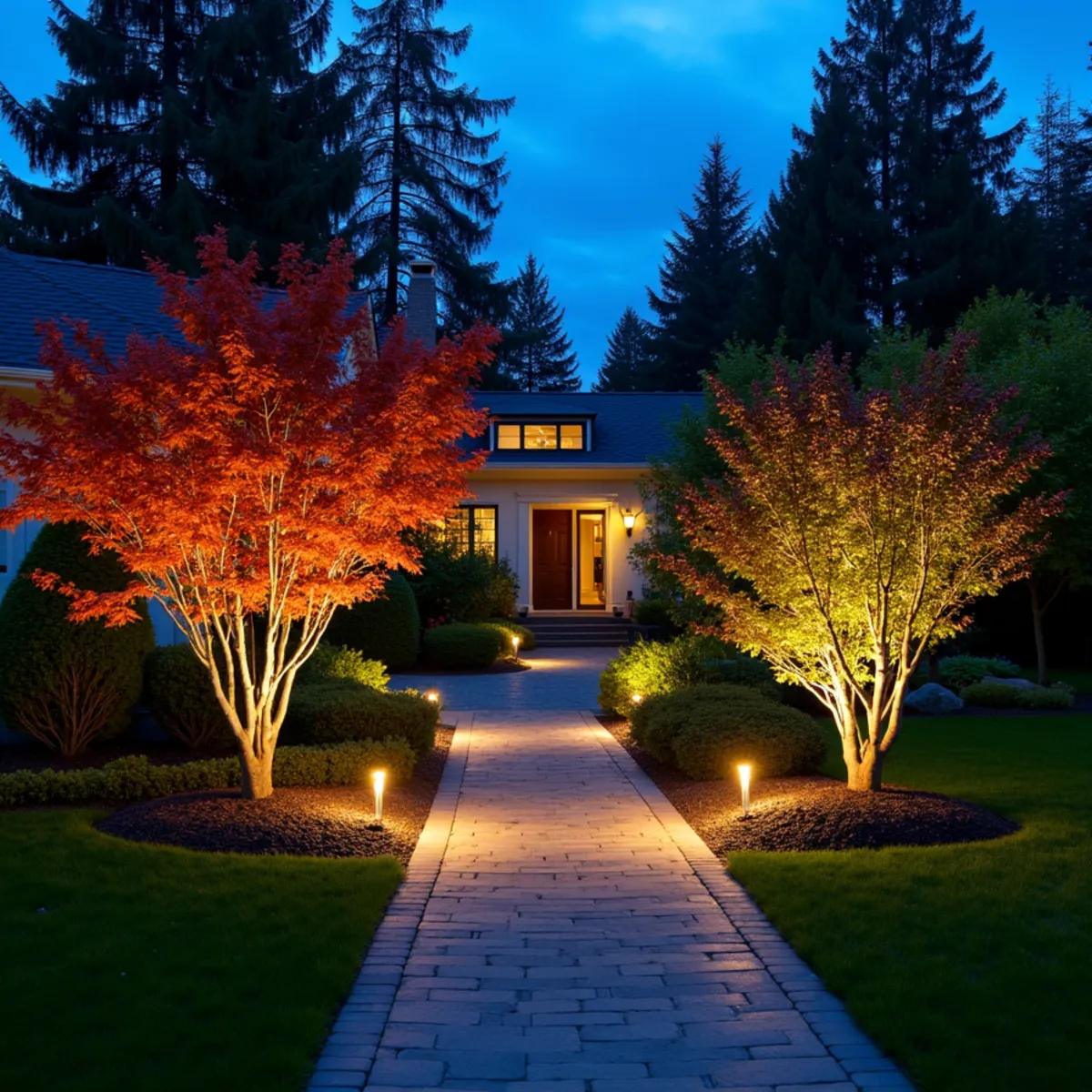
Half the year the Northwest is dark by late afternoon, which means for months you only see your landscape by the light you give it. Good low-voltage lighting changes the entire experience of a property after sunset, making paths and steps safe, drawing out the texture of stone and trees, and turning a patio into a place you actually use on a long evening. It is one of the highest-impact upgrades for how much you enjoy your outdoor space.
We design and install low-voltage LED lighting systems built to survive our wet climate, with weatherproof fixtures, sealed connections, and buried runs that hold up to constant moisture. The design matters as much as the hardware, layering path lights, uplights on specimen trees and architecture, and soft washes on walls and steps so the effect is warm and intentional rather than a runway of identical stakes. Efficient LEDs and a smart transformer keep the whole system sipping power while it runs.
Need Low-Voltage Landscape Lighting in the Seattle area?
Free on-site estimate · 14+ years serving the Eastside
Signs You Need Low-Voltage Landscape Lighting
Dark, unsafe paths and steps
Unlit walkways, stairs, and grade changes are genuine hazards on the long dark evenings we get here, especially when wet. Guests and family miss steps and edges. Well-placed path and step lighting makes moving around the property safe after dark.
Landscape invisible after sunset
The stonework, trees, and plantings you invested in disappear the moment the sun goes down for much of the year. All that curb appeal is dark half the time. Lighting brings the best features forward at night and doubles the hours you enjoy them.
Cheap fixtures that fail in the wet
Big-box kits with unsealed connections and flimsy fixtures corrode and fail fast in our constant moisture, leaving dead sections and repairs every year. It is a false economy. Weatherproof fixtures and properly sealed connections are what last in this climate.
Harsh, uneven lighting
Poorly designed lighting glares in the eyes, over-lights some areas, and leaves others black. It feels like a parking lot, not a landscape. Layered, shielded fixtures and the right beam spreads create a soft, even, inviting effect.
Our Process
- 1
Lighting design walk-through
We walk the property at the scale you use it, identify what to light for safety and beauty, and plan the layers of path, up, and wash lighting.
- 2
Fixture and transformer selection
We specify weatherproof LED fixtures suited to each use and size a transformer with capacity to spare, so the system runs cool and can grow later.
- 3
Wire routing and burial
We route and bury the low-voltage cable along beds and hardscape, planning runs to avoid future digging and to keep voltage consistent across fixtures.
- 4
Fixture placement and mounting
We set and mount each fixture, aiming uplights and positioning path lights precisely, adjusting placement to get the effect right on the ground.
- 5
Sealed connections and hookup
We make every connection with waterproof connectors and tie the system into the transformer and a timer or smart control for automatic operation.
- 6
Night aiming and tuning
We return after dark to fine-tune aim, beam spread, and brightness, because lighting can only truly be dialed in when you see it working at night.
What's Included
- Custom lighting design for safety and beauty
- Weatherproof LED path and step lights
- Tree and architectural uplighting
- Wall washes and grazing on stone and steps
- Patio, deck, and outdoor living lighting
- Properly sized low-voltage transformer
- Buried cable runs planned for consistency
- Waterproof, sealed wire connections
- Timer and smart control integration
- After-dark aiming and final tuning
What Affects the Price
Landscape lighting is priced largely by the number and type of fixtures plus the wiring and transformer to support them. A handful of path lights is a small project, while a full design lighting trees, walls, steps, and outdoor living areas is more involved. We design to your priorities and can phase the system, since a properly sized transformer leaves room to add fixtures later.
| Factor | How it affects your quote |
|---|---|
| Number of fixtures | The count of lights is the main driver, and a full property design uses many more fixtures than a basic path lighting job. |
| Fixture type and quality | Premium brass and copper weatherproof fixtures cost more than basic units but last far longer in our wet climate. |
| Wiring runs and access | Longer cable runs and burying wire across established beds and hardscape add labor to the installation. |
| Transformer and controls | Transformer capacity and smart or timer controls add cost, with extra capacity built in for future expansion. |
| Design complexity | Layered lighting with uplights, washes, and precise aiming takes more design and tuning time than uniform path lights. |
Every property is different — the only way to get an accurate number is a free on-site estimate. Call (323) 606-0255 to schedule.
What Your Line-Item Estimate Includes
We put everything in writing so you can compare bids on the same scope instead of guessing what a total leaves out. Your itemized SeattleProTurf estimate separates:
- Labor and installation
- Materials and delivery
- Site prep, excavation, and haul-off
- Drainage and engineered base work
- Permits and engineering (when required)
- Restoration, cleanup, and site protection
- Payment milestones tied to real progress
- Workmanship warranty terms
Why Choose SeattleProTurf for Low-Voltage Landscape Lighting?
Plenty of contractors can lay turf, stack block, or dig a trench. Building outdoor work that survives Northwest winters takes local knowledge, real engineering, and a crew that is still here to stand behind it. Here is what sets us apart on projects like yours.
14+ years on the Eastside
We have built projects like this across Kirkland and Puget Sound for more than 14 years, so we know exactly how our glacial-till soil and wet winters affect the work.
Licensed, bonded & insured
Registered Washington contractor SEATTPT839LN, with liability and workers' comp coverage — and we handle the engineering and permits when the scope requires them.
Trusted by Eastside homeowners
Homeowners choose us for clean job sites, honest line-item estimates, and installations that hold up season after season.
One accountable local crew
Not a franchise or a lead broker. The same team quotes, builds, and warranties your project — and we are here to stand behind it.
Frequently Asked Questions
Yes, when it is built for it. We use weatherproof fixtures rated for wet conditions and make every connection with sealed, waterproof connectors so moisture cannot corrode them. That is the main failure point of cheap kits here, and doing it right is what keeps the system running season after season.
Very little. LED fixtures draw a fraction of the power of old halogen systems, so even a large layout runs efficiently, and a timer or smart control means it only runs when you want it. The low operating cost is a big part of why LED low-voltage lighting has become the standard.
Yes, and we plan for it. By sizing the transformer with extra capacity and routing the wiring thoughtfully, we make it straightforward to add fixtures as your landscape grows or your priorities change. Phasing a larger design over time is completely workable when the backbone is sized right from the start.
Usually a mix of safety and beauty: paths, steps, and grade changes for safe movement, specimen trees and architecture uplit for drama, and soft washes on walls and seating areas where you gather. We walk the property with you and design layers so the result feels warm and intentional rather than uniform.
Big-box kits typically use undersized wire and a weak transformer, so runs dim toward the far fixtures and connectors corrode in our wet climate within a year or two. A proper install uses correctly sized cable, weatherproof connections, and a transformer sized with headroom for future additions, all balanced so every fixture reads at full brightness. As a landscape lighting contractor in Kirkland WA, we design the layout for both effect and longevity.
LED fixtures are largely maintenance-free with 40,000-plus hour lamp life, so the routine is mostly seasonal: wiping lenses, clearing leaves and moss, and adjusting aim as plants grow in. Quality brass or copper fixtures develop a patina but resist the corrosion that ruins cheap aluminum in our damp winters. We also reprogram timers for the dramatic seasonal shift in Seattle daylight so the system runs efficiently year-round.