
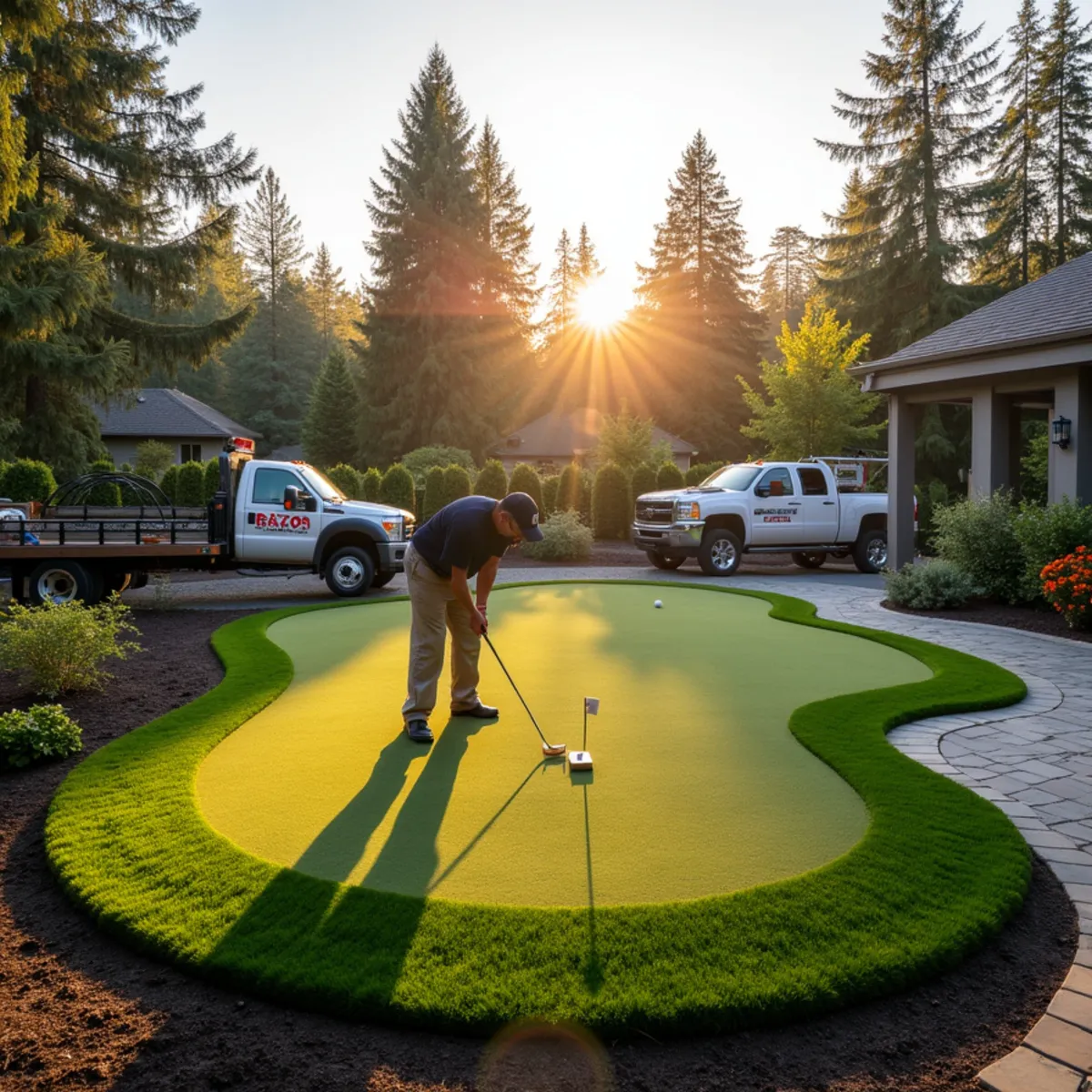
A backyard putting green lets you work on the part of the game that actually lowers scores, and in a climate where the courses are soggy for half the year, a green at home that drains and plays true is genuinely useful. But a putting green is not just short turf, it is a playing surface. The ball roll, the speed, the breaks, and the fringe all have to be built with the same care a course superintendent would give a real green, or it plays flat and disappointing.
We design and build custom putting greens shaped to how you want to practice, with true-roll putting turf, contoured undulations and breaks, cup placements, and a fringe collar that frames the green and adds chipping options. Underneath it all is a laser-graded, free-draining base that holds the contours and sheds our rain, so the green plays consistently and stays firm in wet weather. Whether it is a simple two-cup green or a multi-tier layout with bunkers, we build it to play.
Need Backyard Putting Green Installation in the Seattle area?
Free on-site estimate · 14+ years serving the Eastside
Signs You Need Backyard Putting Green Installation
Nowhere to practice in wet months
Local courses and practice greens are saturated and slow for much of the year, and driving to them for a short session is a hassle. A home green means you can putt whenever you have ten minutes. It turns wasted rainy evenings into practice time.
Cheap greens that do not roll true
A green built like an ordinary turf lawn plays dead, with inconsistent speed and no real break. It quickly stops being fun to use. Proper putting turf, precise base shaping, and correct infill are what create a true, consistent roll.
Contours that do not hold
The breaks and undulations that make a green interesting have to be built into a stable base, or they settle and flatten over time, especially in soil that moves. A poorly based green loses its character. A compacted, laser-graded base locks the contours in place.
Poor drainage on the green
A green that puddles or stays soft is unusable in our climate and plays inconsistently when it is wet. Rain has to move through it cleanly. A free-draining base under the putting surface keeps it firm and playable year-round.
Our Process
- 1
Design and green shaping
We plan the green size, shape, number of cups, and the contours and breaks you want, matching the design to your space and how you like to practice.
- 2
Excavation and rough grading
We excavate the area and rough in the base grade, establishing the overall shape and the drainage fall the green will sit on.
- 3
Base building and contouring
We build and compact the crushed aggregate base, laser-grading and hand-shaping the undulations and breaks so the contours are precise and permanent.
- 4
Cup and drainage setting
We set the regulation cups and cup drainage, and tie the green into a drainage path so water moves through the surface and away cleanly.
- 5
Putting turf and fringe
We install the true-roll putting turf and a contrasting fringe collar, cutting them in tight around the cups and edges for a clean, finished green.
- 6
Infill and roll tuning
We apply and brush the infill to set the green speed, then roll and test the surface so the ball tracks true and holds the intended breaks.
What's Included
- Custom green design and contour planning
- Laser-graded, free-draining aggregate base
- Hand-shaped undulations and breaks
- Regulation cups with cup drainage
- True-roll professional putting turf
- Contrasting fringe collar for chipping
- Multi-tier and multi-cup layouts
- Optional bunkers and chipping areas
- Infill tuned to set green speed
- Surface rolling and roll-quality testing
What Affects the Price
Putting greens are priced by size and complexity, and the contouring is what separates a simple green from a showpiece. A flat two-cup green is far less involved than a multi-tier layout with heavy breaks, a large fringe, and bunkers. We design to your space and budget, then quote the specific green, since the shaping labor is where much of the craft lives.
| Factor | How it affects your quote |
|---|---|
| Green size | Square footage of putting surface and fringe is the primary driver, with larger greens costing more in turf and base. |
| Contour complexity | Multiple tiers, heavy breaks, and detailed shaping take significant hand-grading labor beyond a simple flat green. |
| Number of cups and features | More cups, chipping areas, bunkers, and fringe detailing add materials and labor to the build. |
| Turf quality | Premium true-roll putting turf and quality fringe turf cost more than basic products but play far better. |
| Site and drainage prep | Sloped or wet sites need more base and drainage work to create a stable, free-draining surface for the contours. |
Every property is different — the only way to get an accurate number is a free on-site estimate. Call (323) 606-0255 to schedule.
What Your Line-Item Estimate Includes
We put everything in writing so you can compare bids on the same scope instead of guessing what a total leaves out. Your itemized SeattleProTurf estimate separates:
- Labor and installation
- Materials and delivery
- Site prep, excavation, and haul-off
- Drainage and engineered base work
- Permits and engineering (when required)
- Restoration, cleanup, and site protection
- Payment milestones tied to real progress
- Workmanship warranty terms
Why Choose SeattleProTurf for Backyard Putting Green Installation?
Plenty of contractors can lay turf, stack block, or dig a trench. Building outdoor work that survives Northwest winters takes local knowledge, real engineering, and a crew that is still here to stand behind it. Here is what sets us apart on projects like yours.
14+ years on the Eastside
We have built projects like this across Kirkland and Puget Sound for more than 14 years, so we know exactly how our glacial-till soil and wet winters affect the work.
Licensed, bonded & insured
Registered Washington contractor SEATTPT839LN, with liability and workers' comp coverage — and we handle the engineering and permits when the scope requires them.
Trusted by Eastside homeowners
Homeowners choose us for clean job sites, honest line-item estimates, and installations that hold up season after season.
One accountable local crew
Not a franchise or a lead broker. The same team quotes, builds, and warranties your project — and we are here to stand behind it.
Frequently Asked Questions
It can, when it is built as a playing surface rather than a lawn. True-roll putting turf, a precisely graded and compacted base, and infill tuned to set the speed give you a consistent, honest roll with real break. The base shaping is the difference, which is why we hand-grade the contours rather than just laying turf flat.
Yes, and that is one of the best reasons to have one here. We build the green on a free-draining base so rain passes straight through and the surface stays firm and playable when the local courses are soaked. You can practice on a wet evening without slogging through mud.
Greens can be built to fit a wide range of yards, from a compact two-cup green in a small space to a large multi-tier layout with chipping areas. We design around what you have and how you want to practice. Even a modest footprint can hold a genuinely challenging green with good contouring.
Very little. An occasional brushing to keep the fibers upright and a periodic top-up and leveling of the infill keeps it rolling true, plus clearing leaves and debris. There is no mowing, watering, or chemical program like a real green, which is a big part of the appeal.
The big decisions are green speed and slope, number of holes and cups, fringe versus a chipping apron, and whether to add contours and undulation for practice variety. Faster greens use a shorter, denser nylon turf that demands a flawlessly smooth base, so the sub-base precision drives realism more than the turf grade. We map the layout to how you actually practice rather than defaulting to a flat oval.
Yes, when it's built on a laser-smooth open-graded crushed base that drains vertically, a putting green plays true even through our rainy season and won't hold puddles like natural bentgrass would. The main upkeep is occasional brushing to keep the sand infill level and the roll consistent. Poorly based greens develop birdbaths and inconsistent speed, which is why the base work is where the money should go.