
Emergency? We dispatch 24/7 across the Eastside. Call (323) 606-0255 now for rapid response.
Artificial turf that squishes underfoot, holds puddles, or has started to sink and ripple has a base problem, not a turf problem. The grass on top can be perfectly good while the aggregate beneath it fails to drain, and in our climate a base that does not drain becomes a saturated sponge that never dries out. Water sits in it, it loses support, the surface dips, and it can start to smell. No amount of surface cleaning fixes what is happening underneath.
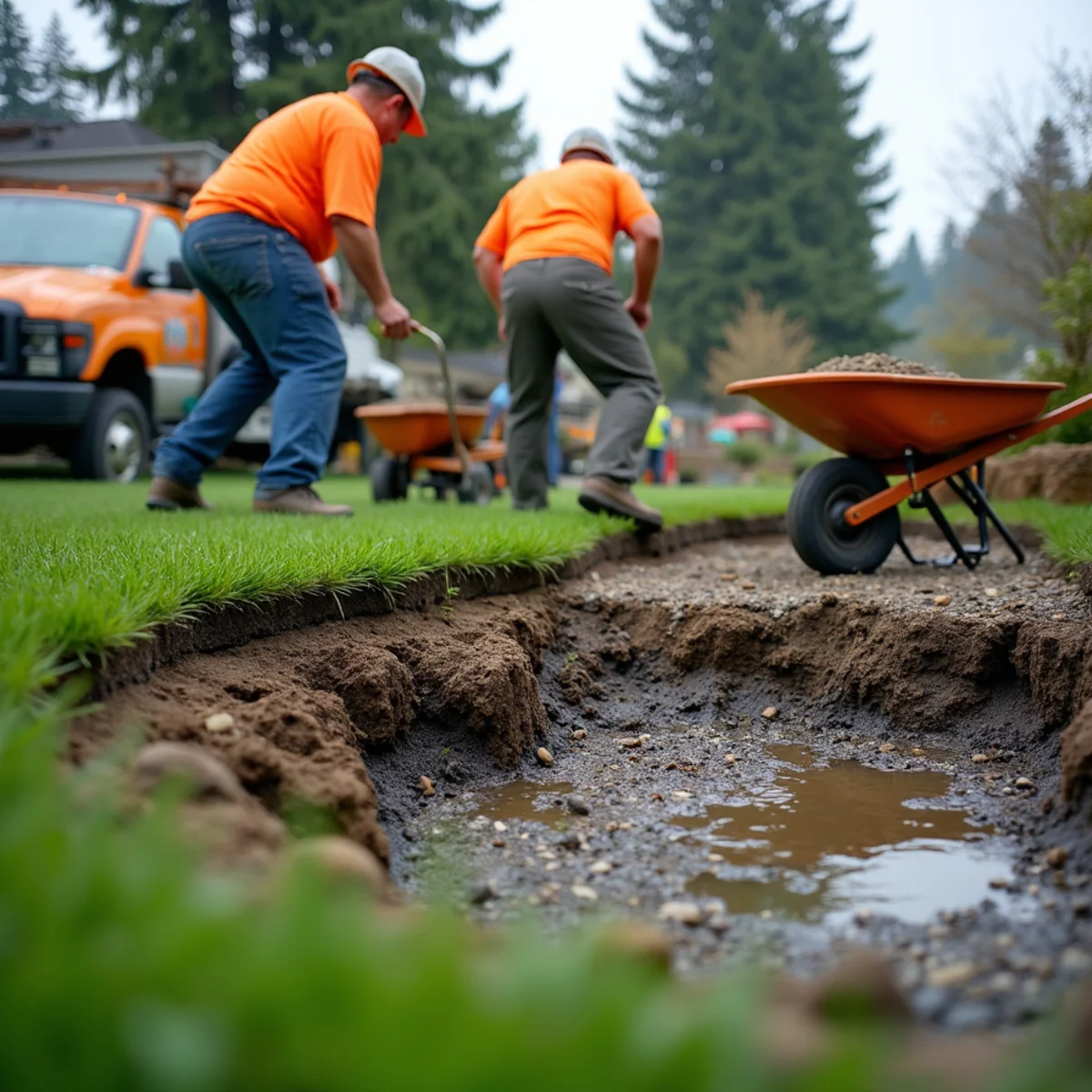
This is almost always the legacy of an install that used the wrong base material or too shallow a base for Pacific Northwest rainfall. We diagnose why the turf is holding water, then lift the turf, correct the grading, and rebuild the sub-base with open-graded 5/8-inch crushed aggregate that drains freely, tying it into real drainage where the site needs it. In many cases the existing turf can be reset over the new base, so you get a firm, dry lawn again without paying for turf twice.
Need Saturated Turf Sub-Base Repair in the Seattle area?
Free on-site estimate · 14+ years serving the Eastside
Signs You Need Saturated Turf Sub-Base Repair
Base that holds water instead of draining
Turf installed over the wrong aggregate, or over compacted native soil, traps water rather than letting it pass through. In a wet climate that base stays saturated for months. The surface never dries and the whole system slowly degrades.
Sinking, dips, and rippling
When water washes fines out of a poor base or the base was never compacted right, the surface settles into dips and the turf ripples or pulls loose. You feel soft, uneven spots underfoot. Only rebuilding the base restores a firm, level surface.
Odor and standing water
A saturated base with poor drainage traps moisture and, in pet areas, urine, which produces persistent odor and puddles that will not clear. Surface rinsing cannot reach the problem. The trapped water in the base has to be given a way out.
Failed or missing drainage tie-in
Even a decent base fails if there is nowhere for the water to go, and many installs skip connecting the turf area to drainage. Water backs up in the base with no outlet. Adding proper drainage lets the rebuilt base do its job.
Our Process
- 1
Diagnosis of the failure
We inspect the base, drainage, and grading to determine why the turf is holding water, so the repair fixes the actual cause rather than just the symptom.
- 2
Careful turf removal
We lift the existing turf carefully, preserving it for reuse when it is still in good condition, and expose the failed base beneath.
- 3
Base excavation
We remove the saturated or wrong-spec base material down to a stable subgrade, clearing out the aggregate that has been trapping water.
- 4
Regrading and drainage
We re-establish positive grade and tie in French drains or a drainage outlet where needed, so water has a defined path away from the area.
- 5
Open-graded base rebuild
We build a new open-graded 5/8-inch crushed aggregate base in compacted lifts, creating a firm, permeable foundation designed for our rainfall.
- 6
Turf reset and grooming
We reset the preserved turf or install new, re-seam and secure it, refresh the infill, and power-broom the surface back to a firm, level, dry finish.
What's Included
- Diagnosis of base and drainage failure
- Careful turf lift for reuse where possible
- Removal of saturated or wrong-spec base
- Re-establishment of positive drainage grade
- French drain and outlet tie-ins as needed
- Open-graded 5/8-inch crushed aggregate rebuild
- Compaction in lifts for a firm surface
- Turf reset, re-seaming, and edge securing
- Fresh infill and power-brooming
- New turf supply when the old is beyond reuse
What Affects the Price
Sub-base repair is priced by the area and how much of the base has to be rebuilt, plus whether new drainage is needed. The big cost question is whether the existing turf can be reused, which we determine on inspection. Reusing sound turf over a new base saves the largest material expense and is often possible when only the base has failed.
| Factor | How it affects your quote |
|---|---|
| Area needing rebuild | Square footage of turf that must be lifted and re-based is the main driver, and localized failures cost less than a full replacement. |
| Turf reuse versus replacement | Sound turf that can be reset over a new base saves significant material cost, while worn or damaged turf must be replaced. |
| Drainage additions | Adding French drains or an outlet where the original install had none increases materials and excavation. |
| Base depth and conditions | How much failed material must be removed and the state of the subgrade affect excavation and new aggregate volume. |
| Access and restoration | Tight backyard access and tying the area back into surrounding hardscape or lawn add labor to the repair. |
Every property is different — the only way to get an accurate number is a free on-site estimate. Call (323) 606-0255 to schedule.
What Your Line-Item Estimate Includes
We put everything in writing so you can compare bids on the same scope instead of guessing what a total leaves out. Your itemized SeattleProTurf estimate separates:
- Labor and installation
- Materials and delivery
- Site prep, excavation, and haul-off
- Drainage and engineered base work
- Permits and engineering (when required)
- Restoration, cleanup, and site protection
- Payment milestones tied to real progress
- Workmanship warranty terms
Why Choose SeattleProTurf for Saturated Turf Sub-Base Repair?
Plenty of contractors can lay turf, stack block, or dig a trench. Building outdoor work that survives Northwest winters takes local knowledge, real engineering, and a crew that is still here to stand behind it. Here is what sets us apart on projects like yours.
14+ years on the Eastside
We have built projects like this across Kirkland and Puget Sound for more than 14 years, so we know exactly how our glacial-till soil and wet winters affect the work.
Licensed, bonded & insured
Registered Washington contractor SEATTPT839LN, with liability and workers' comp coverage — and we handle the engineering and permits when the scope requires them.
Trusted by Eastside homeowners
Homeowners choose us for clean job sites, honest line-item estimates, and installations that hold up season after season.
One accountable local crew
Not a franchise or a lead broker. The same team quotes, builds, and warranties your project — and we are here to stand behind it.
Frequently Asked Questions
The base underneath is not draining. If it was built with the wrong aggregate or too shallow for our rainfall, it holds water like a sponge, loses support, and settles into dips. The turf on top may be fine, which is why the fix is to lift it, rebuild the base with open-graded aggregate, and reset the grass.
Often, yes. When the turf itself is still in good shape and only the base has failed, we can lift it carefully, rebuild the sub-base underneath, and reset the same turf. That avoids paying for new grass. We confirm on inspection whether the turf is sound enough to reuse before we quote.
An open-graded crushed aggregate, typically 5/8-inch, built to adequate depth and compacted in lifts, with the surface graded to drain and tied into an outlet where needed. Open-graded means the stone has void space that lets water pass straight through instead of holding it, which is exactly what our wet winters demand.
Yes, when the odor is coming from a saturated base trapping moisture and urine, which it usually is. Rebuilding with a free-draining base and proper drainage lets liquids pass through and flush out instead of pooling. For pet areas we can also specify antimicrobial infill to keep the surface fresh.
Often yes. When turf holds water it usually means the base was built with fine, poorly draining material or was never compacted to shed water, so we can lift the turf, remove the failed base, and rebuild with open-graded crushed rock that drains vertically. The turf itself is frequently salvageable if the backing and seams are intact. We assess whether a targeted sub-base repair or a full rebuild is the better value.
The usual cause is a base built with rock dust or minus material that packs into a near-impermeable layer, which traps water above our already slow-draining hardpan. Add a decade of organic fines washing in from the surface and drainage grinds to a halt, breeding the odor and moss. A proper repair uses clean angular stone with the right gradation so water keeps moving through the profile for the long haul.