
Emergency? We dispatch 24/7 across the Eastside. Call (323) 606-0255 now for rapid response.
A moving hillside is one of the few landscape problems that endangers the house itself. When a saturated slope starts to slip, mud slumps, cracks open across the ground, trees lean, and the soil that was holding up a yard or holding back a house begins to travel downhill. In our wettest months, weeks of rain load a slope with water until it lets go, and once it starts moving the situation only worsens with every storm.
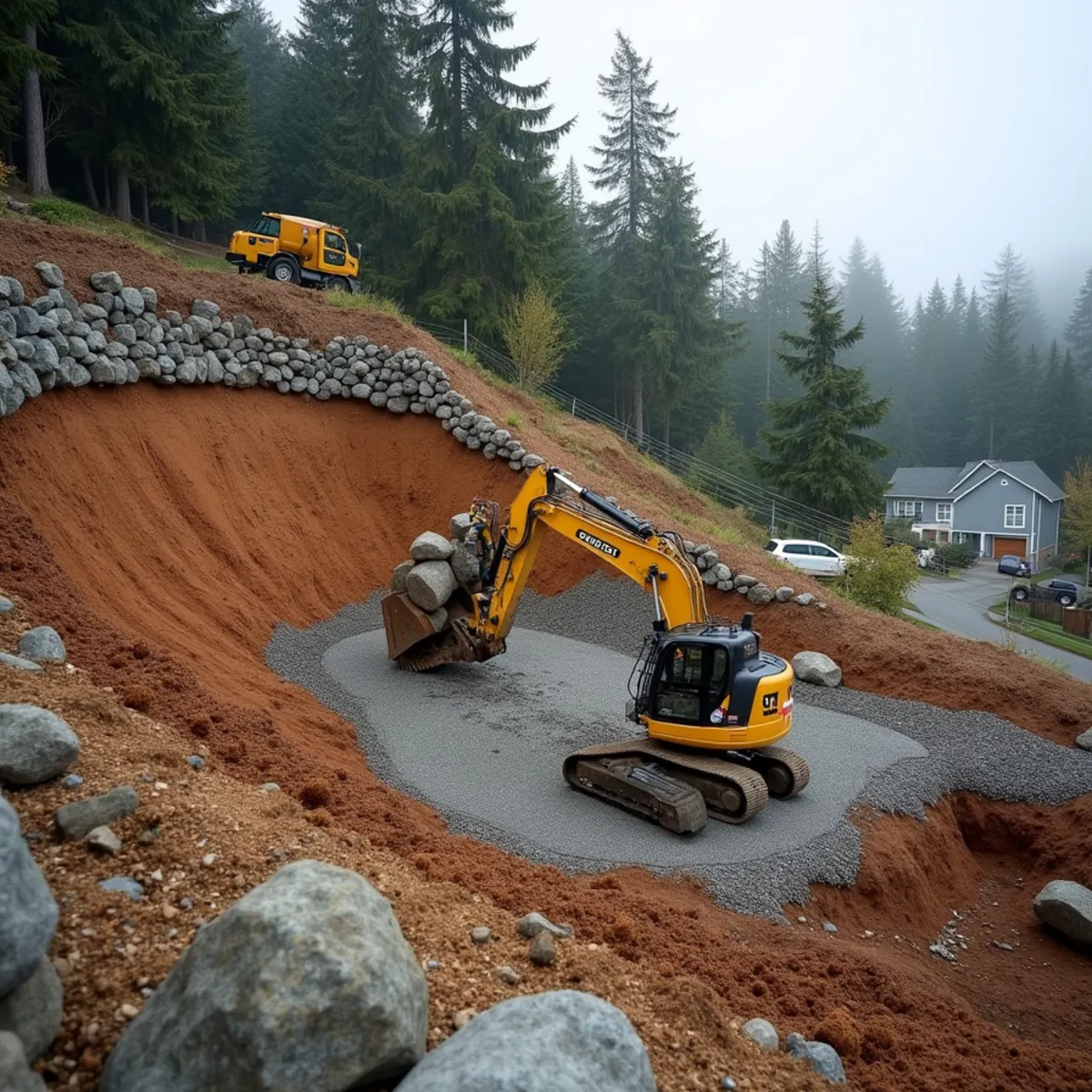
We respond urgently to slope failures and mudslides across the Eastside. The immediate goal is to stop the movement and control the water driving it, then rebuild the slope so it holds. That combines shoring and rockery at the toe, geogrid reinforcement built into the soil, subsurface drainage to relieve the water pressure, and erosion control on the surface. Slope work is engineering as much as excavation, and we treat it that way, bringing in stamped design where the failure requires it.
Need Hillside Slope Stabilization in the Seattle area?
Free on-site estimate · 14+ years serving the Eastside
Signs You Need Hillside Slope Stabilization
Saturated soil losing strength
Weeks of winter rain fill a slope with water until the soil loses the cohesion holding it in place. Fully saturated ground is heavy and weak, and that combination is what turns a stable hillside into a slide. Relieving the water is central to stopping and preventing movement.
Slumping, cracks, and leaning trees
Tension cracks opening across the ground, soil slumping in steps, and trees or fences suddenly tilting are all signs a slope is actively moving. These often appear before a major slide. They are a warning that the hillside needs urgent attention.
Threat to the house above or below
A failing slope can undermine the foundation of a house at its crest or bury and damage a house at its toe. Either way it is a life-safety issue, not just a landscaping one. Stabilizing the slope protects the structures depending on it.
Erosion carrying the yard away
Surface runoff on a bare or steep slope cuts channels and washes soil downhill storm after storm, steadily eroding the usable yard. Left unchecked it undermines whatever is above. Controlling surface water and armoring the slope stops the loss.
Our Process
- 1
Urgent inspection
We respond quickly to assess how far the slope has moved, what is at risk above and below, and whether stamped engineering will be required for the repair.
- 2
Immediate shoring
Where movement is active, we shore the toe and protect structures below, arresting the slide before it progresses further during the next rain.
- 3
Water control
We divert surface runoff off the slope and install subsurface drainage to relieve the water pressure that is driving the failure, the root of most slides here.
- 4
Engineered stabilization plan
We diagnose the failure and design the fix, coordinating geotechnical and structural engineering where the slope height and load require it.
- 5
Reinforcement and rockery
We rebuild the slope with geogrid reinforcement layers, rockery or boulder buttressing at the toe, and compacted structural fill to lock the soil in place.
- 6
Surface erosion control
We finish with erosion control, planting, or matting so surface water no longer cuts into the slope, protecting the stabilization long term.
What's Included
- Urgent slope failure and mudslide response
- Toe shoring and structure protection
- Surface runoff diversion off the slope
- Subsurface drainage to relieve water pressure
- Geotechnical and structural engineering coordination
- Geogrid soil reinforcement layers
- Rockery and boulder buttressing at the toe
- Compacted structural fill rebuild
- Erosion control matting and planting
- Permit coordination for engineered repairs
What Affects the Price
Slope stabilization is scoped after inspection because no two failures are alike, and the cost reflects how much the slope has moved and what it takes to hold it. Emergency shoring to stop active movement is priced to happen fast. The permanent stabilization, reinforcement, drainage, and rockery, is quoted once engineering defines what the slope requires.
| Factor | How it affects your quote |
|---|---|
| Extent of slope movement | A slope caught early with minor slumping costs far less to stabilize than a full slide that has displaced large volumes of soil. |
| Engineering requirements | Significant slopes need geotechnical and structural engineering, which adds design cost and shapes the entire repair approach. |
| Reinforcement and rockery | Geogrid layers, boulder buttressing, and structural fill volume scale with the size and steepness of the slope being rebuilt. |
| Drainage scope | Relieving the water driving the failure can require extensive surface and subsurface drainage, which adds materials and labor. |
| Access and equipment | Steep, unstable, or hard-to-reach hillsides require specialized equipment and slower, safer work, increasing cost. |
Every property is different — the only way to get an accurate number is a free on-site estimate. Call (323) 606-0255 to schedule.
What Your Line-Item Estimate Includes
We put everything in writing so you can compare bids on the same scope instead of guessing what a total leaves out. Your itemized SeattleProTurf estimate separates:
- Labor and installation
- Materials and delivery
- Site prep, excavation, and haul-off
- Drainage and engineered base work
- Permits and engineering (when required)
- Restoration, cleanup, and site protection
- Payment milestones tied to real progress
- Workmanship warranty terms
Why Choose SeattleProTurf for Hillside Slope Stabilization?
Plenty of contractors can lay turf, stack block, or dig a trench. Building outdoor work that survives Northwest winters takes local knowledge, real engineering, and a crew that is still here to stand behind it. Here is what sets us apart on projects like yours.
14+ years on the Eastside
We have built projects like this across Kirkland and Puget Sound for more than 14 years, so we know exactly how our glacial-till soil and wet winters affect the work.
Licensed, bonded & insured
Registered Washington contractor SEATTPT839LN, with liability and workers' comp coverage — and we handle the engineering and permits when the scope requires them.
Trusted by Eastside homeowners
Homeowners choose us for clean job sites, honest line-item estimates, and installations that hold up season after season.
One accountable local crew
Not a franchise or a lead broker. The same team quotes, builds, and warranties your project — and we are here to stand behind it.
Frequently Asked Questions
Tension cracks and slumping are signs of active movement and should be taken seriously, especially in wet weather. Keep people away from the area above and below it and call us at (323) 606-0255 for an urgent inspection. The sooner we can relieve the water pressure and shore the toe, the better the chance of preventing a larger failure.
It is almost always water. Our glacial till sheds surface water, and weeks of winter rain saturate the soil above it until the slope loses strength and lets go. That is why real stabilization always includes drainage to relieve the water pressure, not just structure to hold the soil, which alone would eventually fail again.
For meaningful slope failures, yes. Geotechnical and structural engineering define what the slope actually needs to hold, and permits are typically required. We coordinate that engineering and handle the permitting, then build the stabilization to the stamped design so it is both sound and properly documented.
It can absolutely be planted. Once the structural work and drainage are in, we finish with erosion control and planting so the surface is protected and the slope blends back into your landscape. Deep-rooted plantings actually help hold the surface soil, working with the reinforcement below rather than against it.
Watch for new cracks in the soil, leaning trees or fences, small slumps of earth, seeping water halfway down the slope, and doors or walls in a downhill structure that suddenly stick. On the Eastside these signs intensify after prolonged rain saturates the glacial till and water perches on the clay layer. If you're seeing movement, call (323) 606-0255 before the next storm loads the slope further.
Effective stabilization combines controlling water with reinforcing soil: subsurface and curtain drains to lower the water table, plus measures like geogrid-reinforced structures, terracing, soil nails, or deep-rooted plantings depending on the geology. Because slope work often involves critical-area rules and grading thresholds, it commonly requires a geotechnical report and permits, which we coordinate. A stabilization plan that ignores the water source treats the symptom, not the cause.