Pet Odor & Turf Drainage: Solving Dog Run Smells in Wet Weather
The short answer
Dog-run odor in wet weather comes from urine soaking into a poorly draining base and never fully flushing. Solve it with a free-draining crushed-rock base, antimicrobial pet-grade turf with a permeable backing, an odor-neutralizing infill, and regular rinsing. In Seattle's wet winters, base drainage matters more than any surface deodorizer.
Artificial grass is supposed to make life with a dog easier, not fill the yard with a lingering smell every time it rains. When a pet turf area starts to stink, especially in our damp climate, the odor is not inevitable, it is a sign the turf was not built or maintained for pets. The good news is that a properly designed pet run stays fresh through the wettest winter, and understanding why odor happens is the key to stopping it.
This guide explains why standard artificial grass smells when pets use it, what infill and backing choices actually solve the problem, and how a sensible cleaning routine keeps a dog run clean in Pacific Northwest weather. If your turf in Kirkland, Bellevue, or Mountlake Terrace has developed a pet odor that will not quit, the fix is a matter of getting the drainage and materials right.
Key takeaways
- Wet-weather dog-run odor comes from urine soaking into a base that never fully drains or flushes.
- A free-draining crushed-rock base is the foundation of odor control — surface products can't fix bad drainage.
- Pet-grade turf with a permeable backing lets liquids pass straight through instead of pooling on top.
- Antimicrobial infill (such as zeolite-based products) neutralizes ammonia odor between cleanings.
- Regular rinsing flushes residue down through the base, which matters most during long, damp Seattle winters.
- Correct slope toward a drainage point keeps waste liquids moving out rather than lingering under the surface.
Why Standard Artificial Grass Stinks When Pets Use It
Pet odor in turf comes down to what happens to urine after it lands. On a turf system built for looks rather than pets, urine does not fully drain away, it soaks into a base or infill that holds it, and the ammonia smell builds as it sits and is reactivated every time the area gets wet. That is why the odor often seems worst during and after rain: moisture is releasing the trapped compounds.
Standard landscape turf frequently uses a base and infill designed for stability and appearance, not for flushing liquid straight through. Where drainage is slow or the materials hold organic residue, bacteria go to work and the classic pet-urine smell develops. Our wet climate makes this worse by keeping the whole area damp, so the odor never gets the chance to fully dry out and clear.
The core insight is that pet odor is a drainage and materials problem, not an unavoidable consequence of having a dog. A turf system that lets liquid pass completely through and away, and that resists holding residue, does not develop the smell in the first place. Fixing odor is really about building the run to handle what pets actually do.
Antimicrobial Acrylic Coated Sand vs Silica Infill
Infill, the granular material brushed down into the turf fibers, plays a major role in odor. Basic silica sand infill is inexpensive and fine for many landscape lawns, but it can hold moisture and organic residue in a pet area, giving bacteria and odor a place to develop. For a dog run, the infill choice matters a great deal.
Antimicrobial coated infills are engineered specifically for pets. Products such as acrylic-coated sand carry an antimicrobial treatment that inhibits the bacteria responsible for odor, and their coating helps resist absorbing and holding urine residue, so liquid drains through instead of lingering. In a pet run, this kind of infill is a foundational part of keeping the area fresh.
Choosing pet-appropriate infill from the start is far easier than fighting odor later. Our pet-friendly turf and dog run installations use infill selected for pet use, because the right granular layer is one of the simplest and most effective defenses against the smell that plagues generic turf.
Permeable Hole-Punched vs 100% Porous Flow-Through Backings
Beneath the fibers, the turf's backing determines how fast liquid can escape, and there are two broad types. A conventional perforated backing has drainage holes punched at intervals; water and urine drain through those holes. This works acceptably for general use, but the flow is limited to the holes, and in a heavy-use pet area liquid can spread before it reaches a hole.
A fully porous, flow-through backing is the stronger choice for pets. Instead of relying on punched holes, the entire backing lets liquid pass straight through across its whole surface, so urine drains down immediately wherever the dog goes rather than traveling sideways first. This dramatically reduces the residue left in the fibers and infill, which is exactly what prevents odor from building.
Paired with a properly built, free-draining base and the sub-surface drainage our climate often requires, a flow-through backing gives urine the fastest possible exit. That speed, liquid gone before it can sit, is the heart of an odor-free pet run, and it is why backing choice is not a detail to leave to chance in a dog area.
Enzymatic Turf Cleaners and Routine Washing in NW Rain
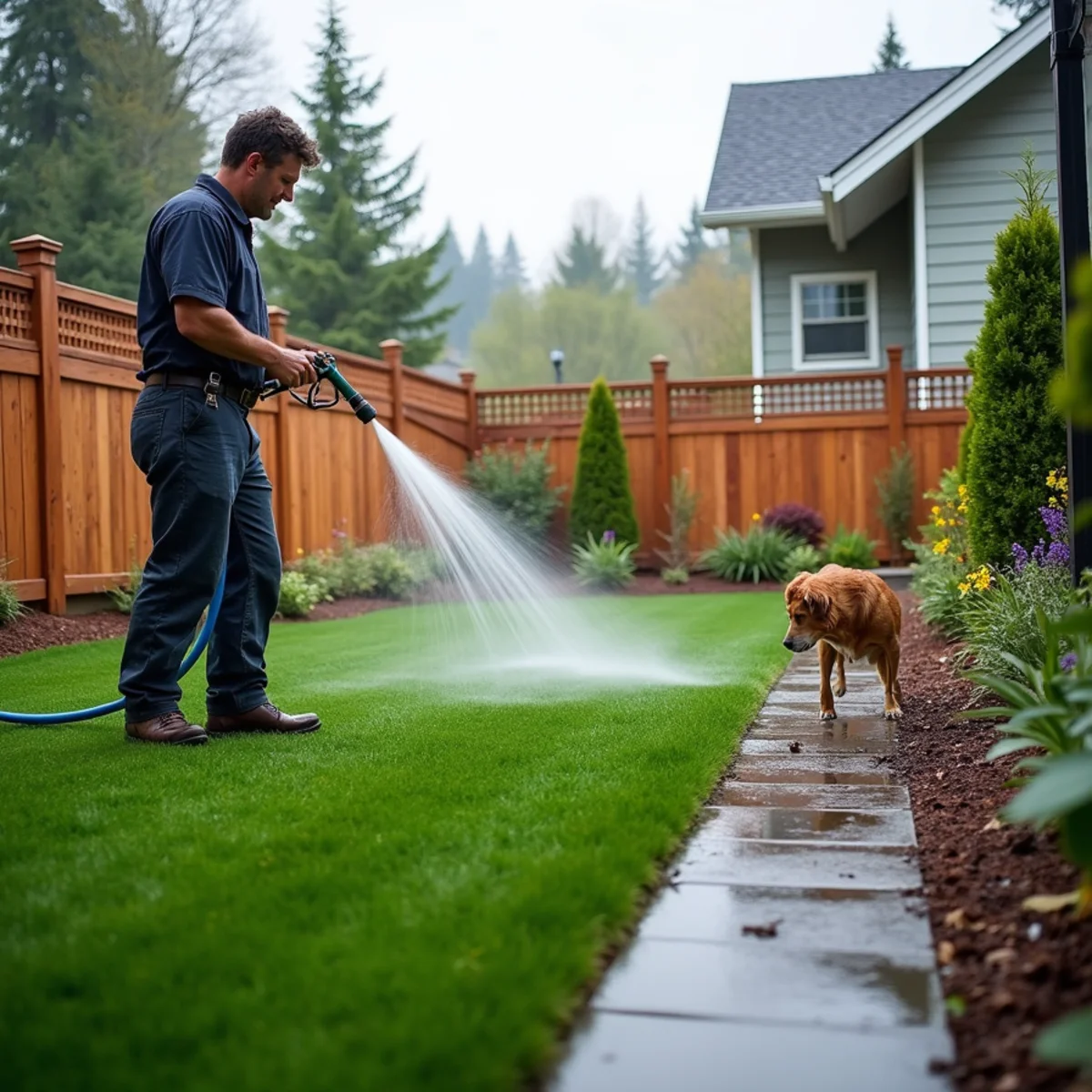
Even the best-built pet turf benefits from simple maintenance, and here our climate actually helps. Regular rinsing flushes residue down through the porous backing and drainage, and in the Pacific Northwest, frequent rain does a good deal of that flushing naturally. A periodic hose-down of the high-traffic spots supplements the rain and keeps things fresh, particularly in drier stretches of summer.
For deeper cleaning, enzymatic turf cleaners are the tool of choice. Unlike ordinary soaps that just mask odor, enzymatic cleaners break down the organic compounds in urine at the source, neutralizing the smell rather than covering it. Applied periodically to a pet run and rinsed through, they keep the area genuinely clean, and they are safe for use around turf and pets when used as directed.
The maintenance a well-built pet run needs is modest: let the rain do much of the work, rinse the busy areas as needed, and use an enzymatic cleaner periodically. That light routine, on a system designed to drain, is all it takes to keep a dog run odor-free through the year, a stark contrast to the losing battle of deodorizing turf that was never built to drain in the first place.
Designing High-Traffic Pet Runs for Easy Cleaning
A great pet run is designed for cleaning from the outset. That starts with the base and drainage, engineered so liquid moves down and away fast, and often includes sub-surface drain lines to carry it off entirely, the same drainage principles that keep any turf from waterlogging on our hardpan. Good drainage is the single most important design factor in an odor-free run.
Layout matters too. Turf can be sloped subtly to encourage flow toward drainage, edged and secured so it stays put under active dogs, and laid out so the high-traffic zones are easy to reach with a hose. Durable, dense turf built for heavy use holds up to running, digging attempts, and daily wear better than a soft landscape grass, which keeps the run looking and smelling better over time.
Designing all of this together, base, drainage, backing, infill, slope, and durable turf, is what produces a dog run that is genuinely low-maintenance rather than a constant chore. It is the difference between a pet area you have to fight and one that simply works, and it is the approach we bring to every pet turf project.
Request a Pet Turf Quote
If your dog run smells, or you want to build one that never will, the solution is a turf system engineered for pets from the base up. We assess your space, your dog's habits, and your drainage, then design a run with the right porous backing, antimicrobial infill, and drainage to keep it fresh through the wettest Seattle winter. Fixing an existing smelly run is often possible too, by correcting the drainage and materials that let the odor develop.
As a licensed, bonded, and insured contractor with over fourteen years installing turf for Eastside pet owners, we know how to build a dog run that stays clean in our climate. Our pet-friendly turf and dog run installations pair proper drainage with pet-specific materials so odor never gets a foothold. Serving Kirkland, Bellevue, Mountlake Terrace, and the surrounding communities, we can give your dog a clean, dry place to play year-round.
Why dog-run turf smells worse in winter, and how the base fixes it
Pet odor on turf is a drainage and infill problem long before it's a cleaning problem. Urine passes through the turf backing fine; the smell comes from what happens below. If the base doesn't drain freely, urine and its ammonia byproducts linger in a damp sub-layer, and in a wet Seattle winter that layer never dries out. That's why owners notice the smell spikes in the rainy months even though the dog's habits didn't change; the base is staying saturated.
The other half is the infill. Standard silica sand does nothing against odor. For dog runs we use an antimicrobial infill and, importantly, build the base to flush cleanly, so a hose or a rain shower actually rinses waste down and out through a daylighted drain rather than into a stagnant pocket. A dog run built like a putting green, with a tight non-draining base, becomes a scent trap.
Maintenance reality: even a well-built pet turf needs an occasional enzyme rinse to break down the residue that plain water leaves behind. That's a five-minute job on a good base and an impossible one on a bad base. The difference is entirely in what was built underneath.
Pro tips from our crew
- Specify an antimicrobial or zeolite-based infill for dog runs; standard silica sand does nothing for odor.
- The base must drain and flush freely; a tight, non-draining base traps urine and concentrates the smell.
- Rinse the run with an enzyme cleaner periodically; plain water leaves residue that plain sand can't neutralize.
- Make sure the run drains to a daylighted outlet, not a buried pocket where waste water sits.
- Keep pile height modest in high-traffic dog lanes; very long pile holds more residue and is harder to rinse clean.
Frequently Asked Questions
Because moisture reactivates urine residue trapped in a base or infill that never drained it away. If the turf was not built for pets, liquid soaks into materials that hold it, and rain releases the ammonia smell. A run with a fully porous backing, pet infill, and proper drainage lets urine pass through immediately, so there is little residue for rain to reactivate.
An antimicrobial coated infill, such as acrylic-coated sand, is designed for pets. It inhibits the bacteria that cause odor and resists absorbing urine residue, so liquid drains through instead of lingering. Basic silica sand is fine for general lawns but can hold moisture and residue in a heavy-use pet area, which encourages odor.
It can often be improved. Odor usually comes from drainage and materials, so correcting the base drainage, replacing or treating the infill, and establishing a proper cleaning routine can resolve it. If the backing itself does not drain well enough for a pet run, replacing that section may be the better long-term fix. An inspection determines which path fits your situation.
Not much, when it is built right. Our frequent rain flushes residue naturally, so you mainly rinse the high-traffic spots as needed and apply an enzymatic cleaner periodically to break down urine at the source. On a system designed to drain, that light routine keeps the run fresh year-round.
Almost always the base. If the sub-base doesn't drain, cleaner and urine sit in a wet layer underneath and the smell keeps coming back regardless of surface cleaning. No amount of top-down washing fixes a base that holds water. We can check whether yours drains and, if not, rebuild it to flush properly; call (323) 606-0255.
On a properly draining base, rain actually helps; it rinses residue down and out for free. On a poorly draining base, rain hurts, because it keeps the sub-layer permanently saturated so the odor never clears. The deciding factor is entirely the base and outlet, which is why we build dog runs to flush rather than to pond.
Pet odor in turf is a solvable drainage and materials problem, not a fact of life with a dog. A run built with a fully porous flow-through backing, antimicrobial pet infill, and proper base and sub-surface drainage lets urine pass through and away before it can sit, and a light cleaning routine, helped along by our own frequent rain, keeps it fresh through the wettest winter.
If your dog run has developed a smell, or you want to build one that stays clean from the start, we design pet turf that works in our climate from the base up. Call Seattle Pro Turf at (323) 606-0255 for a free pet turf consultation and quote, and give your dog a clean, dry place to play all year.
Ready to move from reading to results? Our pet-friendly turf & dog runs and synthetic turf installation crews handle projects like this across the Eastside — including Kirkland and Bellevue. Call (323) 606-0255 for a free estimate.
Get expert help on your project
SeattleProTurf · 14+ years serving the Eastside · Licensed & insured