Permeable Pavers vs Stamped Concrete for Northwest Driveways
The short answer
For Northwest driveways, permeable pavers manage stormwater by letting rain infiltrate through the joints — helping meet impervious-surface rules and resisting freeze-heave — while stamped concrete is cheaper upfront but sheds all water, cracks over time, and gets slick when wet. Pavers cost more initially but are repairable and drainage-friendly.
Choosing a driveway surface in the Pacific Northwest is a decision our climate makes for you more than most homeowners realize. The relentless winter moisture, the wet-dry cycling of our soils, and the increasing weight of city stormwater rules all press on that choice, and the two most popular decorative options, permeable pavers and stamped concrete, respond to those pressures in opposite ways.
Stamped concrete offers a molded, patterned look at a competitive price, while interlocking pavers offer a segmented, flexible surface that can be made permeable. On a magazine driveway in a mild, dry climate the choice would be mostly aesthetic. Here, it is structural, regulatory, and practical. This comparison covers how each material handles our winters, our codes, and our rain, so you can choose a driveway that still looks right a decade from now.
Key takeaways
- Permeable pavers let rain infiltrate through the joints, easing stormwater load and helping meet impervious-surface rules.
- Stamped concrete is cheaper upfront but sheds every drop of water off its surface.
- Concrete is prone to cracking with freeze-thaw and settlement, and repairs mean patching or replacing slabs.
- Individual pavers can be lifted and reset, making repairs and utility access far cleaner.
- Stamped concrete gets slick when wet — a real drawback in the rainy Northwest — while textured pavers hold traction.
- Pavers cost more initially but pay back in drainage performance, code compatibility, and long-term repairability.
Why Stamped Concrete Cracks in Freeze-Thaw Pacific Northwest Winters
Stamped concrete is, structurally, a large monolithic slab dressed up with a pattern and color. That single-pour construction is its fundamental weakness in our climate. Concrete has almost no ability to flex, so when the ground beneath it moves, and Northwest ground moves constantly, the slab has nowhere to release the stress except by cracking.
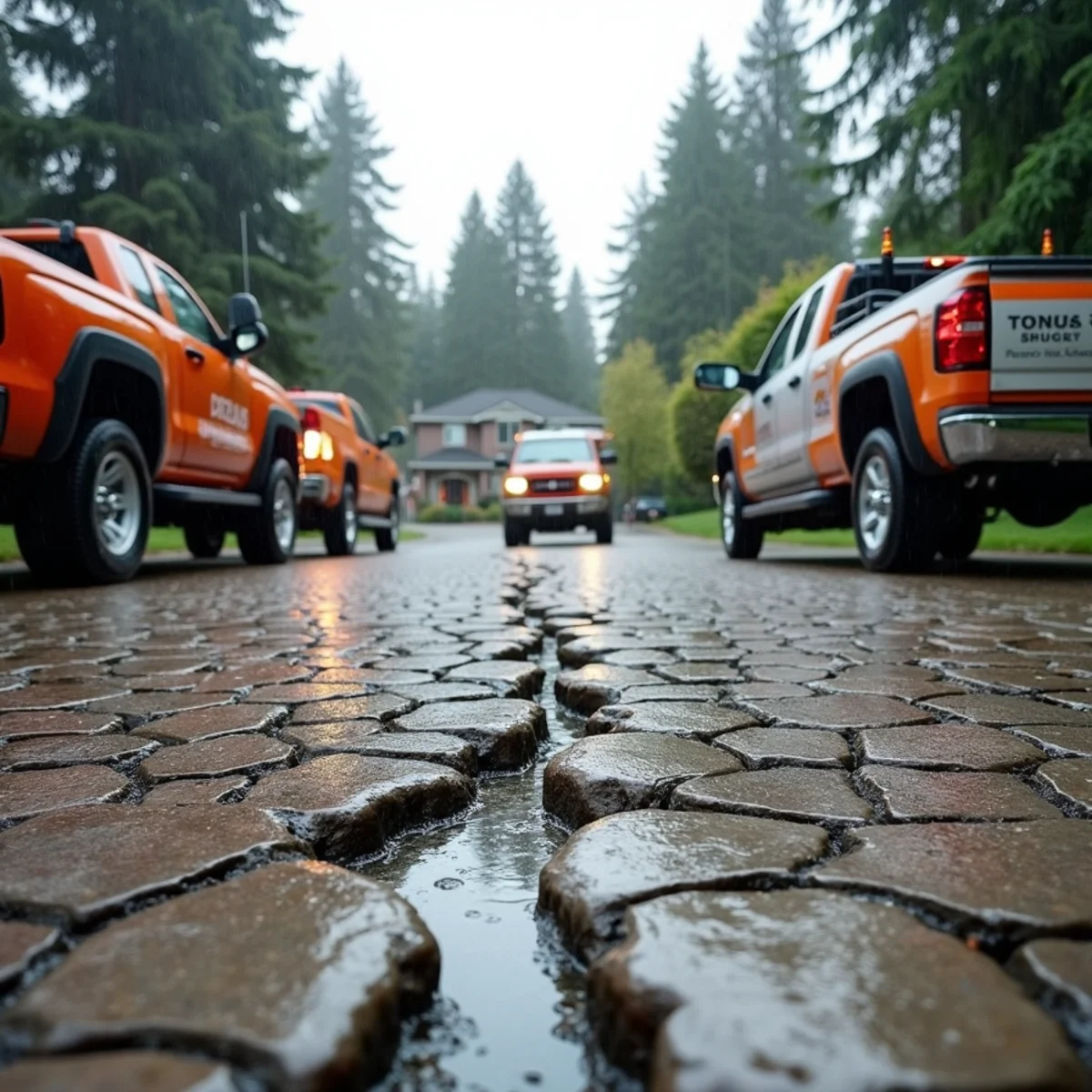
The freeze-thaw cycle drives this. Water works into the surface and the base, and when temperatures dip around freezing overnight, it expands and pries at the concrete from within. Repeated over a wet winter, this spalls the decorative surface and opens cracks that run straight through the pattern. Our glacial till subsoil compounds it by heaving as it saturates and drains, flexing a slab that cannot flex back.
Once a stamped slab cracks, the repair is unsatisfying. Patches never match the color and texture of the original stamp, and the crack telegraphs the underlying movement, so it tends to return. The sealer that keeps stamped concrete looking its best also needs reapplying every few years, adding a maintenance cycle that many homeowners do not anticipate when they choose it for its lower upfront cost.
How Interlocking Pavers Flex with Soil Movement Without Cracking
Interlocking pavers solve the cracking problem by refusing to be a single rigid surface. A paver driveway is hundreds of individual units resting on a compacted crushed-rock base and locked together at the joints. When the ground moves, the field of pavers accommodates it by shifting almost imperceptibly across many joints instead of concentrating the stress into a crack.
That flexibility is exactly the trait our soils demand. As the base beneath expands and contracts through the seasons, the pavers ride with it. Individual stones can settle slightly and be reset without touching the rest of the driveway, so a paver surface can be maintained indefinitely, unit by unit, rather than facing the all-or-nothing failure of a cracked slab.
The base is what makes this work, which is why paver installation is more about the excavation and compacted crushed rock beneath than the stones on top. Built correctly on open-graded aggregate with proper edge restraints, a paver driveway carries vehicle loads for decades and never develops the through-cracks that define aging stamped concrete.
Permeable Pavers and City Impervious Surface Tax Credits
Beyond durability, permeable pavers carry a regulatory advantage that stamped concrete cannot match. A concrete slab is fully impervious: every drop of rain that hits it runs off into the street, the storm system, or your neighbor's yard. Eastside cities increasingly regulate exactly that runoff, and Bellevue in particular enforces impervious-surface and stormwater standards that shape what you can build.
How Permeable Systems Manage Stormwater
Permeable pavers are set with open joints filled with small crushed stone over an open-graded base reservoir. Rain passes through the joints and into the aggregate below, where it is stored and slowly infiltrates into the soil instead of running off. This is water management built into the driveway itself, and it directly serves the stormwater-retention goals our codes are written around.
The Lot-Coverage Advantage
Because permeable systems infiltrate rather than shed water, many jurisdictions treat them more favorably than solid concrete when calculating a lot's impervious coverage. For a homeowner bumping against a lot-coverage cap during a renovation, choosing permeable pavers over a slab can be the difference between an approvable plan and one that requires added detention. It is worth confirming the specifics with your city, but the structural principle consistently favors the permeable option.
Slip Resistance in Wet Rainy Weather: Pavers vs Slick Concrete
Safety underfoot is an underrated part of this comparison, and it matters more here than almost anywhere because our surfaces are wet for so much of the year. Sealed stamped concrete can become genuinely slick when wet, especially on the sloped driveways common on Eastside lots. The same sealer that protects the decorative finish reduces its traction in exactly the conditions we have most.
Pavers offer more grip. Their segmented surface, textured finishes, and the open or sanded joints between units break up water and give shoes and tires more to hold. Permeable pavers add another layer of safety by draining the surface water away rather than letting it sheet across the top, so puddles and the thin films that cause slips simply do not form the way they do on a slab.
Aesthetic Variations: Belgard Cobblestones vs Modern Slabs
Neither material has to compromise on looks, and the aesthetic range on the paver side is genuinely wide. Manufacturers like Belgard produce everything from tumbled old-world cobblestones to large-format modern slabs with crisp edges, so a paver driveway can read as traditional or contemporary depending on the unit, pattern, and color you choose. That flexibility lets the driveway match the architecture rather than fight it.
Stamped concrete imitates these looks with molds and pigments, and from a distance a fresh stamp can be convincing. The difference shows up over time. Pavers hold their color and texture because each unit is a manufactured, through-colored stone, while stamped concrete's surface color and crisp pattern fade and wear, and the seams of the stamp mats can become visible. If the goal is a driveway that still looks intentional and rich after ten Northwest winters, the durability of real pavers usually carries the aesthetic argument too.
Get a Custom Driveway Consultation
The right driveway depends on your slope, your soil, your lot-coverage situation, and how the surface will be used, and those factors are best evaluated on-site rather than from a catalog. A consultation lets us look at your grade and drainage, check whether a permeable system helps you with local impervious-surface limits, and match a paver style to your home.
Seattle Pro Turf builds paver and permeable-paver driveways across Kirkland, Bellevue, and Mercer Island, and as a licensed, bonded, and insured Washington contractor (SEATTPT839LN) we handle the base engineering and drainage that make the surface last. We also install French drains and yard drainage when a driveway project reveals a larger water problem, so the whole system works together.
Why we steer most Eastside driveways toward permeable pavers
Stamped concrete photographs beautifully and costs less up front, but our climate is unusually hard on it. Freeze-thaw cycles are mild here, yet the constant winter wet works into any hairline crack, and once a stamped slab cracks it cannot be repaired invisibly; you see the patch forever. The surface sealer that keeps the color vivid also gets slick when wet, which matters on a sloped Kirkland driveway during eight months of rain. Resealing every couple of years is a real recurring cost people forget when they compare the initial bids.
Permeable pavers cost more to install because the base is the product. A proper permeable system is an open-graded aggregate reservoir, often a foot or more deep, that stores and infiltrates stormwater on site. That depth is exactly why it helps with Bellevue and Eastside impervious-surface and drainage rules: a permeable driveway can count differently than a solid slab, which sometimes lets a homeowner build the square footage they actually want without a detention vault. The individual pavers are also repairable one at a time, so a heaved or stained unit lifts out and swaps in.
The catch homeowners miss is maintenance of the joints. Permeable systems infiltrate through the open aggregate in the joints, and over years that fills with silt, moss, and conifer debris. If it is never vacuumed or refreshed, it clogs and starts shedding water like any hard surface. It is low-maintenance, not no-maintenance, and on a needle-dropping Eastside lot the joints need attention.
Pro tips from our crew
- Ask whether a permeable driveway can offset your impervious-surface calculation before you assume you need an expensive detention system; the answer often changes the design.
- On any sloped driveway, weigh wet-weather traction; a sealed stamped surface can be slick for eight months a year here, while paver texture stays grippier.
- Budget stamped concrete's resealing cycle into the comparison, not just the install price, since color and slip resistance both depend on it.
- For permeable systems, plan an annual joint cleaning to clear silt and needles so the aggregate keeps infiltrating.
- Confirm the permeable base depth is engineered for your soil; over tight glacial till, infiltration is slow and the reservoir has to be sized accordingly.
Frequently Asked Questions
It can suit budget-driven projects or flat, well-drained sites where movement is minimal, and it costs less upfront. The trade-offs are its tendency to crack with soil movement and freeze-thaw, its slickness when sealed, and its fully impervious runoff, all of which matter more on sloped, clay-soil Eastside lots.
Yes. Because permeable pavers infiltrate rain into an aggregate reservoir instead of shedding it, they align with the stormwater-retention and impervious-surface goals Bellevue's codes are built around, and many jurisdictions treat them more favorably in lot-coverage calculations. Confirm the specifics for your parcel with the city before finalizing plans.
Pavers typically cost more upfront because most of the work is in the excavation and compacted base. Over the driveway's life, though, pavers avoid the resealing, cracking, and full-slab replacement that stamped concrete tends to require, which narrows or reverses the cost difference.
They infiltrate more slowly over glacial till than over sandy soil, so the design has to account for it. We size the open-graded aggregate reservoir deeper to store water and let it release gradually, and in very tight soils we sometimes add an underdrain so the system still functions as designed. Properly engineered, a permeable driveway manages Northwest rainfall on site; poorly sized, it just becomes an expensive puddle.
Both look upscale, but permeable pavers tend to hold value better here because they age gracefully and repair invisibly, while stamped concrete's cracks and faded sealer read as deferred maintenance to buyers. Permeable systems can also be a selling point where drainage codes are strict. If you want a side-by-side estimate for your lot, call (323) 606-0255.
For a Pacific Northwest driveway, the comparison keeps returning to the same theme: our climate rewards a surface that flexes, drains, and can be maintained piece by piece, and it punishes a rigid slab that can only crack. Stamped concrete offers a lower entry price and a molded look, but permeable pavers answer our freeze-thaw winters, our stormwater codes, and our wet, sloped lots in ways a concrete pour simply cannot.
If you are weighing a new driveway or replacing one that has already started to crack, the smartest first step is an on-site look at your slope, soil, and drainage. Call Seattle Pro Turf at (323) 606-0255 for a custom driveway consultation and a straight answer on which surface will serve your property best.
Ready to move from reading to results? Our paver patios & walkways and french drains & yard drainage crews handle projects like this across the Eastside — including Kirkland and Bellevue. Call (323) 606-0255 for a free estimate.
Get expert help on your project
SeattleProTurf · 14+ years serving the Eastside · Licensed & insured